
Contents
By Bedroom Style Reviews Editorial Team
Estimated Reading Time: 10 Minutes
2026 US Guide
The mattress industry is changing rapidly.
For decades, mattress shopping was mainly about choosing between foam, springs, latex, or hybrid construction. While those materials remain important, technology is becoming a much bigger part of the conversation in 2026.
Modern mattresses and smart beds can now incorporate temperature management, adjustable firmness, sleep tracking, automated positioning, pressure sensing, and app-connected controls.
This doesn’t mean every sleeper needs a high-tech mattress. Traditional mattresses remain excellent choices for many people.
Instead, the growing smart-sleep category is giving consumers more options for customizing their sleep environment.
For American households, the biggest development is the move toward mattresses and beds that can respond to individual preferences rather than offering only one fixed comfort level.
What Is Smart Mattress Technology?
Smart mattress technology refers to mattresses, adjustable bases, sensors, and related systems that use technology to monitor or modify aspects of the sleep environment.
Depending on the product, features can include:
- Temperature regulation
- Adjustable firmness
- Automated elevation
- Sleep tracking
- Pressure sensing
- Snore-responsive positioning
- Smart alarms
- Smartphone controls
- Personalized sleep insights
Not every smart mattress includes all of these features.
Some products focus primarily on temperature control, while others concentrate on adjustable positioning or sleep monitoring.
This makes it important to compare the actual features rather than assuming that every product marketed as a smart bed works in the same way.
Temperature Regulation Is a Major Trend
Temperature management remains one of the most important developments in modern mattress technology.
A mattress can influence how much heat builds up around the sleeper. Manufacturers are therefore experimenting with breathable materials, cooling covers, phase-change materials, airflow designs, and active temperature-control systems.
Some smart beds go further by allowing users to adjust temperature settings through controls or smartphone applications.
This can be particularly appealing to couples who prefer different sleeping temperatures.
Rather than choosing one temperature for the entire bed, certain systems are designed to provide individualized settings for different sides.
The important distinction is that passive cooling and active temperature control are not the same thing.
A breathable mattress may reduce heat buildup, while an active system can potentially regulate temperature more directly.
Smart Beds Are Becoming More Personalized
Personalization is one of the strongest themes in 2026 sleep technology.
Traditional mattresses generally provide one fixed firmness and feel.
Smart systems can offer more flexibility.
Adjustable bases allow sleepers to change the position of the upper body or legs. Some advanced systems also allow different settings on each side of the bed.
This can be especially useful for couples with different preferences.
One person may prefer a flatter sleeping position while another may prefer a slightly elevated position.
Instead of compromising on one fixed configuration, adjustable technology can provide separate settings.
Adjustable Bases Are Part of the Smart Sleep Trend
The mattress itself is only one component of a smart sleep system.
Adjustable bases have become increasingly connected to smart-bed technology.
Modern adjustable bases can offer controls for different positions and may connect with mobile applications or other sleep features.
Some systems are also designed to make it easier to adjust the bed for activities such as reading or watching television.
When considering an adjustable base, mattress compatibility is important.
Not every mattress is designed to work with every adjustable foundation, so consumers should always check compatibility before purchasing.
Sleep Tracking Is Moving Into the Bedroom
Sleep tracking is no longer limited to watches and rings.
Smart mattresses and bedside systems can also incorporate sensors that collect information related to sleep patterns.
Depending on the technology, these systems may monitor movement, heart rate, breathing patterns, sleep timing, or other signals.
The information can then be presented through an app.
This creates a more integrated approach to sleep tracking because the technology is built into the sleeping environment rather than requiring the user to wear a device.
However, consumers should remember that consumer sleep tracking provides estimates rather than the same measurements obtained through a clinical sleep study.
AI Is Changing Sleep Insights
Artificial intelligence is becoming increasingly important across the wider sleep-technology industry.
Instead of simply collecting data, newer systems can analyze patterns and provide personalized insights.
For example, software may compare sleep data across multiple nights and identify changes in sleep duration, bedtime consistency, movement, or other available measurements.
The objective is to make large amounts of data easier to understand.
AI-powered insights can be useful for identifying patterns, but they should not be confused with medical diagnosis.
The most useful role for AI is helping consumers understand their habits and make practical adjustments to their sleep environment.
Smart Mattress Technology for Couples
Couples are one of the groups that may benefit most from mattress personalization.
Two people sharing a bed can have completely different preferences for firmness, temperature, and sleeping position.
A traditional mattress requires both sleepers to use the same surface.
Some smart mattress systems address this by providing independent controls for each side.
For example, one side may have a different firmness or temperature setting from the other.
This can reduce the need for couples to compromise on every aspect of their sleeping environment.
The technology can also be useful when one person tends to sleep warmer than the other.
Pressure Mapping and Personalized Support
Pressure distribution is another area where technology is influencing mattress design.
Sensors can be used to understand how weight is distributed across a mattress surface.
Some advanced systems use this information to provide more personalized support.
The long-term direction is toward mattresses that can potentially respond to individual body position rather than simply providing one uniform surface.
This is an area where consumers should pay attention to the actual technology behind marketing claims.
A mattress that uses pressure-sensitive technology may provide a different experience from a conventional mattress, but the value depends on how effectively the system responds to the sleeper.
Smart Snore-Response Features
Some adjustable smart beds are designed to respond when snoring is detected.
The system may detect patterns associated with snoring and adjust the sleeping position.
The concept is relatively simple: changing upper-body elevation may alter the sleeper’s position.
However, consumers should not view these features as a treatment for sleep disorders.
Persistent or concerning breathing problems during sleep should be discussed with an appropriate healthcare professional rather than managed solely through a smart-bed feature.
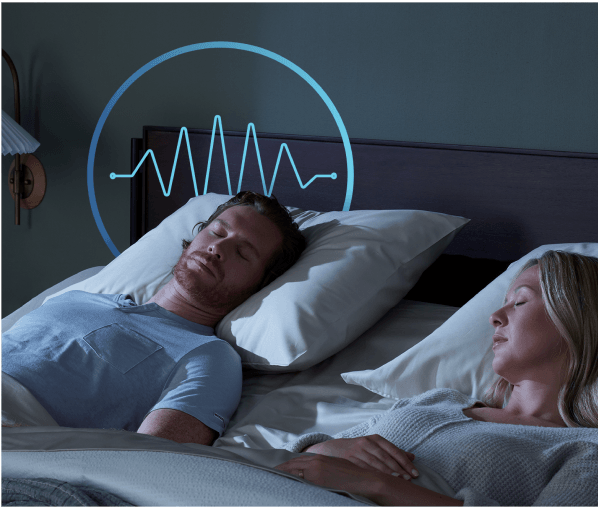
Smart Alarms and Gentle Wake Features
Smart alarms are another growing feature in connected sleep systems.
Instead of simply setting a fixed alarm time, some technologies attempt to identify an appropriate point within a user’s estimated sleep cycle or wake window.
The idea is to make waking feel less abrupt.
Some smart beds and sleep systems also use gradual changes in lighting, sound, or bed position as part of a wake-up routine.
These features can make the bedroom feel more personalized without requiring significant effort from the user.
The Smart Bedroom Is Becoming a Connected System
Mattress technology increasingly connects with other bedroom technology.
A future-oriented smart bedroom may include:
- Smart mattress
- Adjustable bed base
- Smart lighting
- Temperature control
- Sleep tracking
- Smart speakers
- Automated curtains
- Air-quality monitoring
The goal is to create an environment that can adapt to the user’s routines.
For example, evening lighting can become softer as bedtime approaches, while the bedroom environment can be adjusted for nighttime comfort.
The mattress becomes one part of a larger sleep ecosystem.
Natural Materials Still Matter
Technology hasn’t made traditional mattress materials irrelevant.
Foam, latex, coils, cotton, wool, and other materials continue to influence comfort and durability.
In fact, one of the most interesting 2026 trends is the combination of advanced technology with more natural-looking and breathable materials.
Consumers increasingly want both functionality and a comfortable physical experience.
A mattress can have advanced sensors and smart controls, but the actual sleeping surface still needs to feel comfortable.
Technology should complement good mattress construction rather than replace it.
Hybrid Mattresses Continue to Evolve
Hybrid mattresses combine different construction methods, often using coils with foam or other comfort materials.
This format remains relevant because it can provide a balance of support, responsiveness, and cushioning.
Modern hybrid designs may also incorporate cooling covers, zoned support, reinforced edges, or other technologies.
For consumers who don’t want a fully connected smart mattress, an advanced hybrid can provide many modern features without requiring an app or electronic system.
This makes hybrid mattresses an important part of the 2026 market.
Smart Mattress Technology and Energy Use
Electronic sleep technology introduces another consideration: energy consumption.
Traditional mattresses don’t require electricity.
Smart beds and temperature-control systems may need continuous or periodic power depending on how they operate.
Consumers interested in smart sleep products should consider energy requirements, standby consumption, and what happens if power is interrupted.
This is particularly relevant for households trying to reduce energy use.
The convenience of technology should be balanced with practical considerations such as operating costs and maintenance.
Privacy and Smart Beds
Connected mattresses can collect highly personal information.
Sleep timing, movement patterns, temperature preferences, and other data may be stored in an app or cloud service.
Before purchasing a connected sleep product, consumers should understand:
- What data is collected
- How long information is retained
- Where data is stored
- Whether information is shared
- Which permissions are required
- Whether data can be deleted
- Whether features require a subscription
A mattress may feel like a private household product, but a connected mattress can function partly like a digital device.
Privacy therefore deserves the same attention given to other smart-home products.
Do You Need a Smart Mattress?
Not necessarily.
A high-tech mattress isn’t automatically better than a traditional mattress.
If a conventional mattress provides good comfort, support, temperature management, and durability, there may be little reason to replace it simply for technology.
Smart features become more valuable when they solve a specific problem.
For example, adjustable positioning may be useful to someone who wants more control over bed position. Temperature technology may appeal to people who struggle with different temperature preferences. Sleep tracking may interest people who want to monitor long-term sleep patterns.
The best mattress is still the one that meets the sleeper’s actual needs.
What to Consider Before Buying a Smart Mattress
Before investing in smart mattress technology, consider the following factors.
First, determine which feature matters most.
If temperature regulation is the priority, there is little reason to pay for a system filled with features that won’t be used.
Next, check the mattress and base compatibility.
Also consider the warranty. Smart mattresses contain more components than conventional mattresses, so understanding coverage is particularly important.
Subscription costs should also be considered. Some connected products may require ongoing fees for advanced features.
Finally, think about long-term reliability.
A traditional mattress has relatively few components that can fail. A smart system may contain electronics, sensors, motors, software, and connectivity features.
Convenience should be balanced against complexity.
Smart Mattress Trends to Watch in 2026
Several developments are shaping the smart sleep market this year.
More Personalized Temperature Control
Temperature management is moving toward individualized settings, particularly for couples.
Better Sleep Data Integration
Sleep information is increasingly being combined with activity and wellness data to create broader insights.
More Responsive Adjustable Beds
Adjustable bases are becoming more automated and connected to apps and other sleep technologies.
AI-Powered Sleep Recommendations
AI is increasingly being used to turn sleep data into easier-to-understand recommendations.
Contactless Sleep Monitoring
Non-wearable sensors are providing alternatives for people who don’t want to sleep with a watch or ring.
Connected Smart Bedrooms
Mattresses, lighting, temperature controls, and other bedroom devices are increasingly being considered as one system.
The Future of Mattress Technology
The future of mattresses is likely to be less about adding technology simply for the sake of technology and more about personalization.
A conventional mattress provides a fixed experience.
The emerging smart-bed model attempts to create a more adaptable experience.
Future systems may become better at recognizing individual preferences, adjusting temperature, changing support, and coordinating the bedroom environment.
However, simplicity will continue to have value.
Some consumers will always prefer a comfortable mattress without apps, sensors, motors, or subscriptions.
That means the mattress market is likely to move in two directions at once: increasingly sophisticated smart systems for people who want personalization and simpler high-quality mattresses for those who prefer a traditional approach.
Conclusion
Mattress technology is becoming an increasingly important part of the 2026 sleep landscape.
Smart beds, adjustable bases, temperature-control systems, sleep tracking, AI-powered insights, and personalized settings are changing what consumers can expect from a modern sleep environment.
But technology should not become the main reason for buying a mattress.
Comfort, support, materials, durability, size, and overall construction remain fundamental.
For shoppers interested in smart sleep technology, the best approach is to identify the feature that genuinely solves a problem and then choose a system around that need.
A smart mattress can make a bedroom more adaptable and personalized, but the ultimate goal remains simple: creating a comfortable environment that supports better nights of sleep.
© 2026 bedroomstylereviews.com — All Rights Reserved
Affiliate Disclosure: We earn a commission from qualifying Amazon purchases. All opinions are our own.

Dan is the founder and head content creator at Bedroom Style Reviews.
He has been working as a professional online product reviewer since 2015 and was inspired to start this website when he ended up sleeping on a memory foam mattress that was too soft and gave him backache.
Through in-depth research and analysis, Dan’s goal with this website is to help others avoid such pitfalls by creating the best online resource for helping you find your ideal mattress, bedding, and bedroom furniture.
Dan is a qualified NVQ Level 2 Fitness Instructor with 6 years’ experience helping clients improve their health through diet, exercise, and proper sleep hygiene.
He also holds several college and university-level qualifications in health sciences, psychology, mathematics, art, and digital media creation – which helps him to publish well researched and informative product reviews as well as articles on sleep, health, wellbeing, and home decor.
Dan also has direct personal experience with insomnia, anxiety, misophonia (hypersensitivity to sounds), and pain from both acute and long-standing sporting injuries – he enjoys writing insightful articles around these subjects to help fellow sufferers of such conditions.
Learn more about Dan here.