
Contents
2026 TREND GUIDE
By Bedroom Style Reviews Editorial Team
Storage is the invisible architecture of a great bedroom — when it works, the room feels calm, spacious, and effortlessly organised; when it fails, clutter accumulates, surfaces disappear under miscellany, and the sanctuary quality of the room is progressively eroded. In 2026, the science and art of bedroom storage have advanced significantly, driven by urban space constraints, the decluttering movement, and a generation of furniture designers who understand that beautiful storage is not a contradiction in terms — it is the foundation of a beautiful room.
This comprehensive guide covers thirty bedroom storage ideas organised across five strategic domains, from maximising wardrobe efficiency to creating ingenious hidden storage in furniture and architecture. Solutions are provided for every room size, every budget, and every aesthetic preference.

DOMAIN 1: BED STORAGE — MAXIMISING THE ROOM’S LARGEST PIECE
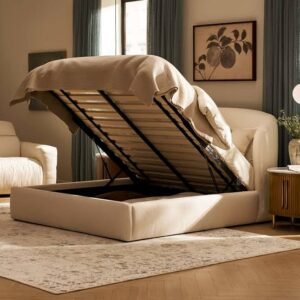
1. Hydraulic Lift Storage Bed
A hydraulic or gas-lift platform bed that rises from the foot of the bed to reveal a large storage cavity beneath the mattress is the single highest-capacity bedroom storage solution available. In a standard king-size bed, the under-mattress storage space can accommodate two full sets of bedding, several large seasonal clothing items, and additional miscellaneous storage in a single, completely concealed cavity. The mechanism is simple to operate — most require a single hand to lift the mattress and base to a stable open position — and the storage is completely hidden when the bed is in its normal position, contributing nothing to the visual clutter of the room.
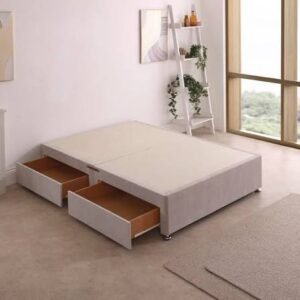
2. Divan Base with Storage Drawers
A divan bed base with two, four, or more integrated storage drawers provides easy-access, separated storage beneath the mattress. Unlike the single undifferentiated cavity of a lift-storage bed, divan drawers allow logical organisation by category — one drawer for out-of-season clothing, one for extra bedding, one for accessories. In 2026, the best divan storage beds feature full-extension drawers with soft-close runners that access the full depth of the cavity, rather than the shallow, difficult-to-access drawers of older designs.
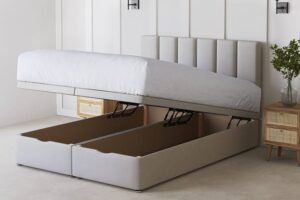
3. Ottoman Storage Beds
Ottoman beds open from the foot of the bed — the entire mattress and base rise toward the headboard — revealing a wide, shallow storage trough that runs the full length and width of the bed. This design provides maximum visual accessibility to the contents compared to lift-storage beds (which open from the foot, potentially requiring bending to reach items at the far end). Ottoman beds are particularly well-suited to storing large, flat items — extra blankets, spare pillows, seasonal duvets — that benefit from being spread out rather than compressed.
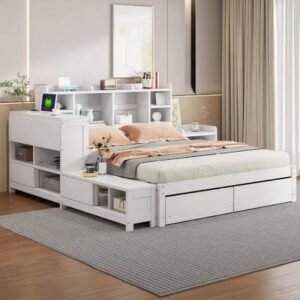
4. Bed Frame with Integrated Headboard Storage
Some 2026 bed frame designs incorporate storage shelving, cubby holes, or closed compartments within or behind the headboard — creating accessible nightstand-equivalent storage that does not require additional furniture. These integrated headboard storage designs range from simple open shelves (suited to books, water bottles, and phone charging) to fully enclosed cabinets with push-to-open doors (suited to items that benefit from concealment). They are particularly valuable in rooms where space beside the bed is insufficient for separate nightstands.
DOMAIN 2: WARDROBE STORAGE ORGANISATION
5. Zone Your Wardrobe by Category
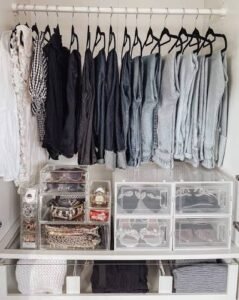
The most impactful wardrobe organisation improvement requires no new furniture at all — simply restructuring the existing wardrobe space into clear category zones. A well-zoned wardrobe in 2026 typically includes: a hanging zone for long items (dresses, coats, suits); a hanging zone for short items (jackets, shirts, folded trousers on hangers); a folded clothing zone (knitwear, t-shirts, jeans) using the KonMari vertical folding method that allows every item to be seen without lifting others; a shelved zone for bags and accessories; a drawer zone for underwear and socks; and a shoe zone with a dedicated shoe rack or clear-lidded shoe boxes.
6. Slimline Velvet Hangers
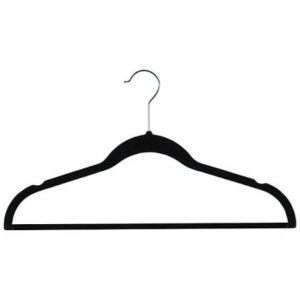
Replacing plastic or wire hangers with slim, non-slip velvet hangers is one of the most impactful, lowest-cost wardrobe transformations available. Standard plastic hangers are typically 8-10mm thick; premium velvet hangers are 5-6mm, creating a 30-40% increase in available hanging space within the same rail length. The non-slip surface also prevents items from falling off the hanger and reduces the bunching that creates creasing in hung clothing. A set of 50 velvet hangers costs approximately £12-£20 and takes thirty minutes to implement — the wardrobe change is immediately dramatic.
7. Double Hanging Rods
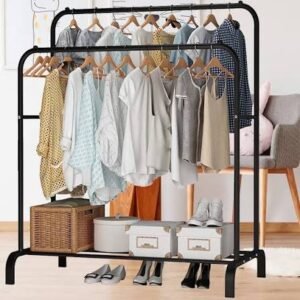
Adding a second, lower-hanging rod beneath the primary rail — using an inexpensive hanging rod extender attachment — can nearly double the hanging capacity for shorter clothing items such as shirts, jackets, folded trousers, and skirts. This modification requires no tools, costs under £10, and immediately transforms a single-rail wardrobe into a significantly more efficient double-tier storage system. It is most effective when all short-hanging items are consolidated onto the lower rail and all long-hanging items onto the upper, creating two distinct, accessible zones.
8. Behind-Door Storage
The inside of wardrobe doors is a commonly overlooked storage surface. Door-mounted shoe organisers, hook strips, jewellery organiser pockets, and hook-and-loop accessory panels can transform unused door surfaces into high-density storage for small accessories, jewellery, belts, scarves, and shoes. In 2026, over-door organisers with clear pockets allow the contents to be seen at a glance without removing items — one of the most practical storage innovations for smaller accessories.

DOMAIN 3: VERTICAL STORAGE STRATEGIES
9. Floor-to-Ceiling Shelving
Vertical wall space above standard furniture height — the dead zone between the top of the wardrobe or dresser and the ceiling — represents significant untapped storage capacity in most bedrooms. Floor-to-ceiling built-in or freestanding shelving that utilises this vertical space can dramatically increase a room’s total storage capacity without increasing its footprint. In 2026, modular shelving systems that can be precisely configured to the room’s dimensions and the owner’s storage requirements will be available from several major furniture retailers in quality materials and finishes that look genuinely built-in.

10. Stack, Don’t Spread
The fundamental principle of vertical storage maximisation is to stack items rather than spreading them horizontally. Stackable storage boxes in a uniform size, stacked luggage, vertically stored flat boards and artwork, and file-folder-style clothing organisation all apply this principle to reduce the footprint of storage while maintaining the capacity. When selecting stackable storage boxes, prioritise structural integrity — boxes that sag or deform under load create instability that makes vertical stacking impractical and potentially hazardous.
11. Alcove Storage
Chimney breast alcoves — the recesses on either side of a fireplace breast — are among the most under-utilised storage opportunities in bedrooms of period properties. Building bespoke shelving, drawer units, or a combination of both within these alcoves uses space that is architecturally dead for any other purpose, creates a bespoke, built-in appearance that significantly elevates the room’s quality, and can provide substantial additional storage without reducing the room’s usable floor area. In 2026, painted MDF alcove units are the most popular approach — providing a clean, integrated look at significantly lower cost than solid wood cabinetry.

DOMAIN 4: SURFACES AND NIGHTSTANDS
12-20: Clever Surface Storage Strategies
- The tray method: Gathering loose items on a surface into a single tray or bowl instantly creates the visual impression of organisation. A leather tray on the nightstand containing phone, watch, and charger looks intentional; the same items scattered without containment look chaotic.
- Bedside caddy: A fabric caddy that hangs over the side of the mattress, attaching between the mattress and base, provides immediately accessible storage for books, phone, glasses, and other frequently accessed bedside items without requiring any additional furniture.
- Floating shelves: A narrow floating shelf at nightstand height, mounted to the wall beside the bed, provides all the functional bbenefitsof a nightstand with zero floor footprint — ideal for very small bedrooms where conventional nightstands cannot fit comfortably.
- Pegboard systems: A bedroom pegboard wall — a perforated board with a system of hooks, shelves, and storage accessories — can create highly flexible, fully visible, and easily reconfigurable storage for accessories, bags, and frequently used items.
- Magnetic knife strips for accessories: Metal bobby pins, hair clips, barrettes, and other small metal accessories can be stored on a small magnetic strip mounted inside a wardrobe door or on a wall — providing instantly visible, easily accessible, zero-footprint storage.
- Clear, uniform storage containers: Standardising all storage boxes, baskets, and containers to a single uniform style creates a visual coherence on open shelves and in visible storage areas that reads as highly organised and intentional, regardless of the actual contents.
- Shoe boxes repurposed: Matching shoe boxes stacked on wardrobe shelves create an inexpensive, visually uniform storage system for accessories, seasonal items, and miscellany that is both practical and aesthetically clean.
- Tension rod dividers: Adjustable tension rods installed vertically within drawers or horizontal shelves create bespoke dividers for folded clothing, clutch bags, and board books that prevent items from collapsing into disorganised piles.
- The one-in-one-out rule: The most sustainable storage strategy of all — for every new item brought into the bedroom, one existing item is removed. This prevents the accumulation that overwhelms even the best storage systems over time.
DOMAIN 5: HIDDEN AND ARCHITECTURAL STORAGE
21-30: Creative Hidden Storage Solutions
- Window seat storage: A custom or flatpack window seat bench with a hinged lid creates both a seating or reading nook and a significant storage cavity below — one of the most elegant and space-efficient dual-purpose installations in bedroom design.
- Hollow staircase storage: In rooms with a mezzanine level, spiral staircase, or access to adjacent loft space, the hollow space beneath stairs is a high-value hidden storage cavity suitable for seasonal items, luggage, and large, rarely-used objects.
- Integrated headboard cabinets: Bespoke headboard units that incorporate flanking wardrobe or cabinet columns on either side create a dramatically space-efficient bedroom storage solution that unifies storage and bed into a single architectural piece.
- False ceiling voids: In some rooms, creating a false ceiling that incorporates a void space above can provide concealed storage accessible via a hatch — most applicable in attic rooms or properties where the ceiling can be modified.
- Behind-bed shallow shelving: A 20-25cm-deep built-in shelf running the full width of the wall behind the bed, just above headboard height, creates an elegant display and storage ledge visible from the bed that holds books, lamps, plants, and accessories without any floor footprint.
- Radiator cover with shelf: A fitted radiator cover topped with a shelf converts a visually disruptive radiator into a useful surface and storage piece — particularly effective in bedrooms where the radiator position makes furniture placement awkward.
- Ceiling-mounted storage: In bedrooms with exposed beams or industrial-style architecture, ceiling-mounted hanging systems using fabric pouches, hanging baskets, or suspended shelves can provide storage that is both functional and aesthetically striking.
- Mirror with secret storage: Framed mirrors that open to reveal shallow hidden storage — for jewellery, small accessories, or personal documents — combine a practical and aesthetic object with concealed organisation.
- Kickboard drawers: In bedrooms with built-in fitted units, the kickboard area (the recessed panel at floor level) can be converted to shallow pull-out drawers for storing flat items — an often-overlooked storage cavity that requires minimal structural modification.
- The seasonal storage system: A systematic approach to rotating seasonal items in and out of accessible storage — keeping only the current season’s clothing and bedding immediately accessible while storing other seasons in vacuum bags or labelled boxes in a loft or garage — can halve the total in-bedroom storage requirement.
© 2026 bedroomstylereviews.com — All Rights Reserved
Affiliate Disclosure: We earn commission from qualifying Amazon purchases. All opinions are our own.

Dan is the founder and head content creator at Bedroom Style Reviews.
He has been working as a professional online product reviewer since 2015 and was inspired to start this website when he ended up sleeping on a memory foam mattress that was too soft and gave him backache.
Through in-depth research and analysis, Dan’s goal with this website is to help others avoid such pitfalls by creating the best online resource for helping you find your ideal mattress, bedding, and bedroom furniture.
Dan is a qualified NVQ Level 2 Fitness Instructor with 6 years’ experience helping clients improve their health through diet, exercise, and proper sleep hygiene.
He also holds several college and university-level qualifications in health sciences, psychology, mathematics, art, and digital media creation – which helps him to publish well researched and informative product reviews as well as articles on sleep, health, wellbeing, and home decor.
Dan also has direct personal experience with insomnia, anxiety, misophonia (hypersensitivity to sounds), and pain from both acute and long-standing sporting injuries – he enjoys writing insightful articles around these subjects to help fellow sufferers of such conditions.
Learn more about Dan here.