
Contents
2026 TREND GUIDE
By Bedroom Style Reviews Editorial Team
Bedroom lighting is arguably the most overlooked and simultaneously most impactful design element in the bedroom. A beautifully furnished room with poor lighting will always feel less impressive and less comfortable than it should. Conversely, a modestly furnished room with expertly designed lighting can feel warm, atmospheric, and genuinely luxurious. In 2026, advances in smart lighting technology, LED quality, and circadian-science-informed product design have made excellent bedroom lighting more accessible and more impactful than at any previous point.
This guide covers the complete bedroom lighting strategy — from understanding the three essential lighting layers to specific product recommendations, smart technology integration, and the sleep science of colour temperature that should inform every bedroom lighting decision.
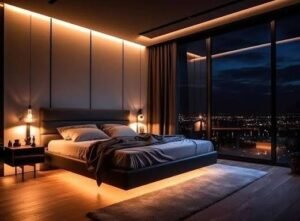
❝ “Lighting is the single cheapest and most powerful room transformation tool available. The same room can feel cold, institutional, and uninviting under a single overhead fluorescent, and warm, intimate, and luxurious under layered warm LED sources. Nothing else achieves this transformation at this cost.” ❞
PART 1: THE THREE ESSENTIAL LIGHTING LAYERS
Layer 1: Ambient Lighting — The Foundation
Ambient lighting — also called general lighting — provides the room’s overall illumination level, allowing safe navigation and the performance of basic room functions without creating targeted work light or decorative atmosphere. In the bedroom, ambient lighting is most commonly provided by a ceiling-mounted fixture, a pendant light, or a series of recessed downlights. The critical characteristic of effective bedroom ambient lighting is its controllability: a dimmer switch is not optional but essential, allowing the ambient light level to transition from functional daytime illumination to a low, atmospheric evening level that supports the pre-sleep wind-down process.
In 2026, the most popular bedroom ambient lighting approach is a combination of a statement central pendant or ceiling fixture — acting as both a functional light source and a design feature — with supplementary recessed downlights around the room’s perimeter. This combination provides even illumination without the harsh shadows that a single central source creates, and allows sections of the room to be lit independently for different activities.
- Recommended colour temperature for ambient bedroom lighting: 2700K-3000K (warm white). Never use 4000K+ (cool white) in a bedroom ambient light.
- Recommended lumen output: 1,500-2,500 lumens total ambient for a standard bedroom (15-20 square metres). Adjust upward for larger rooms.
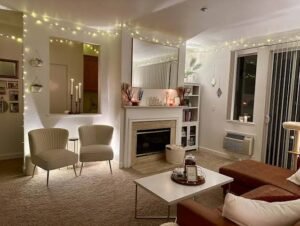
A cozy living room illuminated by warm fairy lights, featuring a classic fireplace and comfortable seating for a relaxing evening.
Layer 2: Task Lighting — The Practical Layer
Task lighting provides focused illumination for specific activities that require a higher light level than ambient lighting supplies — most importantly, reading in bed, but also dressing at a mirror, working at a desk within the bedroom, or applying makeup at a vanity. In the bedroom context, task lighting most commonly takes the form of bedside reading lights — either wall-mounted swing-arm lamps, table lamps with directional shades, or clip-on lights attached to the headboard or beside a table.
The most important ergonomic consideration in bedside task lighting is the position of the light source relative to the reading material and the reader’s eyes. The light should illuminate the page without shining directly into the reader’s eyes or creating glare on the page surface. A wall-mounted, adjustable swing-arm lamp positioned so that it directs light downward over the shoulder toward the page is widely regarded as the ergonomically optimal bedside task light configuration. In 2026, lamps with a built-in dimmer and a CCT (correlated colour temperature) switch — allowing a shift from cool, high-lumen reading light to warm, low-lumen sleep-preparation light — are particularly valued.

Layer 3: Accent and Mood Lighting — The Atmosphere Layer
Accent and mood lighting create atmosphere, highlight architectural features or display objects, and provide the warm, dim, low-level illumination that characterises the most inviting bedroom environments. This layer includes: LED strip lights concealed within built-in wardrobes or beneath the bed frame to create a floating effect; small decorative table lamps on shelving that provide a warm, glowing presence rather than a functional light source; fairy lights or canopy lights above the bed for a romantic, soft overhead effect; and wall-mounted picture lights that highlight artwork or create localised warm pools of light.
In 2026, the bedroom floor lamp is experiencing a strong design revival, particularly in living spaces but increasingly in larger bedrooms — a tall, arching floor lamp behind the bedside chair or reading nook creates a pool of warm, focused light at the perfect height for seated reading and adds a strong vertical design element that contributes positively to the room’s overall aesthetic.
PART 2: THE SLEEP SCIENCE OF COLOUR TEMPERATURE
Understanding Colour Temperature and Its Circadian Impact
Light colour temperature — measured in Kelvin (K) — describes the spectral composition of a light source, specifically the relative proportion of blue-spectrum and red-spectrum wavelengths it emits. This matters profoundly for bedroom lighting because the human circadian system is exquisitely sensitive to blue-spectrum light (approximately 480nm wavelength), which is the primary signal the suprachiasmatic nucleus in the brain uses to assess the time of day.
Exposure to blue-spectrum light (high Kelvin, 4000K-6500K, appearing cold/white) suppresses the production of melatonin — the hormone that drives sleepiness — and advances the circadian clock, signalling that it is daytime. Exposure to red-spectrum light (low Kelvin, 1800K-3000K, appearing warm/orange) has minimal circadian effect and allows the natural melatonin rise that accompanies the approach of sleep time. The practical implication is unambiguous: all bedroom lighting used in the evening should be warm (2700K or below) and dim. Cold, bright lighting in the bedroom in the hours before sleep is one of the most readily correctable causes of delayed sleep onset in the modern home.
★ Blue light exposure in the two hours before bed delays sleep onset by an average of 90 minutes and reduces melatonin production by up to 55% (Harvard Medical School, 2024).
Smart Bulb Technology for Circadian-Aligned Lighting
The most sophisticated bedroom lighting solution in 2026 is a smart bulb system that automatically adjusts colour temperature throughout the day in alignment with the circadian rhythm — providing cooler, higher-lumen light during the morning and daytime, and transitioning progressively to warmer, lower-lumen light from late afternoon through evening and into the pre-sleep period. Several major smart bulb manufacturers now offer this circadian mode as a standard feature, and integration with sleep tracking apps allows the lighting schedule to be synchronised with your specific sleep timing data.
Even a basic smart bulb system — where you manually switch between a daytime and an evening colour temperature preset — represents a meaningful improvement over static warm-white bulbs. In 2026, the Kelvin range of smart bulbs spans from approximately 1,800K (candle-warm, deepest sleep preparation mode) to 6,500K (daylight), providing genuine flexibility for every use case within a single bulb.
PART 3: SPECIFIC BEDROOM LIGHTING SCENARIOS
Lighting for a Small Bedroom
Small bedrooms benefit from lighting strategies that create a sense of visual depth and spaciousness. Multiple light sources at different heights create more perceived depth than a single overhead source. Wall-mounted sconces free up nightstand surfaces while adding midpoint lighting that makes the walls appear to recede. Uplighting — directing light upward toward the ceiling — creates a sense of height and expansion that is particularly effective in rooms with lower ceilings. Avoid pendant lights in small bedrooms with standard ceiling heights, as they can reduce headroom and make the ceiling feel lower.
Lighting for a Master Bedroom
A master bedroom lighting scheme should be its most sophisticated — accommodating the full range of the room’s uses from dressing and grooming to evening relaxation and sleep preparation. Key components include: a dimmer-controlled ambient pendant or ceiling fixture; bedside task lighting on both sides of the bed; vanity or dressing table lighting with a CRI (colour rendering index) of 90+ and a neutral 3000K temperature for accurate colour assessment; wardrobe interior lighting for ease of clothing selection; and at least one or two accent light sources for atmosphere.
Lighting for a Teenage Bedroom
A teenager’s bedroom has lighting needs that span from study and homework (requiring bright, focused, cool-toned task light) to socialising and relaxation (wanting warm, atmospheric, controllable mood lighting) to sleep (needing circadian-friendly warm and dim light). A smart bulb system with multiple programmable scenes is the most practical solution for this range of needs, allowing the teenager to switch between a focused study mode, a relaxed social mode, and a sleep preparation mode without changing any physical bulbs or fixtures.
PRO TIP: Install a smart lighting switch or smart plug in a teenage bedroom rather than replacing all bulbs — smart switches can add dimming and scene control to any existing light fixture for under £30.
PART 4: THE BEDROOM LIGHTING PRODUCT CHECKLIST 2026
- Main ambient light: Pendant or ceiling fixture with dimmer capability and a 2700K colour temperature.
- Bedside task lights: Wall-mounted swing-arm or adjustable table lamps on both sides of the bed.
- Smart bulbs: At least in the main ambient fixture and bedside lamps — for circadian temperature adjustment.
- Dimmer switches: For every light circuit in the bedroom.
- Accent lighting: LED strips, decorative table lamps, or a floor lamp for atmosphere.
- Blackout capability: Curtains or blinds that completely block external light when needed.
- Night light: A very low-lumen, warm (1800K) night light for safe navigation without circadian disruption.
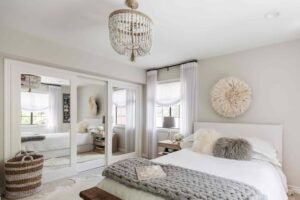
A serene modern bedroom featuring mirrored wardrobes, soft neutral tones, and elegant lighting.
© 2026 bedroomstylereviews.com — All Rights Reserved
Affiliate Disclosure: We earn commission from qualifying Amazon purchases. All opinions are our own.

Dan is the founder and head content creator at Bedroom Style Reviews.
He has been working as a professional online product reviewer since 2015 and was inspired to start this website when he ended up sleeping on a memory foam mattress that was too soft and gave him backache.
Through in-depth research and analysis, Dan’s goal with this website is to help others avoid such pitfalls by creating the best online resource for helping you find your ideal mattress, bedding, and bedroom furniture.
Dan is a qualified NVQ Level 2 Fitness Instructor with 6 years’ experience helping clients improve their health through diet, exercise, and proper sleep hygiene.
He also holds several college and university-level qualifications in health sciences, psychology, mathematics, art, and digital media creation – which helps him to publish well researched and informative product reviews as well as articles on sleep, health, wellbeing, and home decor.
Dan also has direct personal experience with insomnia, anxiety, misophonia (hypersensitivity to sounds), and pain from both acute and long-standing sporting injuries – he enjoys writing insightful articles around these subjects to help fellow sufferers of such conditions.
Learn more about Dan here.